Saturday, June 14, 2014

Trumpet Vine (Campsis Radicans)

Trumpet vine is growing up the hedges (Chinese Privet) in between my neighbors house and ours. It might have been there for years but I never actually noticed it until last year. It's also growing up the trees on a woodsy lot in our neighborhood and can grow up to 30 feet high. Trumpet Vine is native to Eastern, North-central and South-central United States. It is a food source for the Ruby-throated Hummingbird  and bees love to visit it also. Trumpet Vine is NOT edible and all parts are toxic. So admire it's beauty only. Contact with the leaves or flowers can cause inflammation and blisters so if handling gloves might be needed. I never realized until recently just how many plants in my yard and area actually could cause this reaction. My understanding is growing of God's creation that can and has caused me much discomfort and pain in the past. I stand protected and covered in their midst now. :)

Lift up thy voice like a trumpet, Isaiah 58:1

Trumpet Vine (Campsis Radicans)

Trumpet Vine (Campsis Radicans)

Trumpet Vine (Campsis Radicans) growing up the trees in our neighborhood. 

Trumpet Vine (Campsis Radicans)


Mimosa (Albizia Julibrissin)

The pink Mimosa trees were not here when we moved to this house in 1977. My parents bought two right before the pool was to be built a year later. One through carelessness of the people building the pool was run over or into and didn't live. The other tree did and through that one others spread through our yard. The original one was blown over in a storm and probably good it did. It was right next to the storage building and was too large for where it was located. None to worry because we have no lack of Mimosa trees here. Mimosa trees can be a bit of a mess though. Those pretty pink flowers fall off everywhere and since these are near concrete they are having to be constantly sweept away. Not to mention the seed pods and leaves. The leaves close during the night and if raining. In some countries it's name means "night sleeper" and "sleeping tree". The blossoms are edible and leaves can be boiled but NOT the seeds or seed pods they are poisonous. I've never tried the blossoms and not tempted to since frequently there are little green worms hanging from them. :) The Chinese use the bark as a remedy for anxiety, depression and insomnia and I found much interesting information about this. I have no recommendation but it would be worth looking into if someone had problems in these areas. As always use caution if trying new plants as edibles or medicinal. Be well informed and expert advice is always recommended. I'm discovering so much information of what has been all around me. Take some time and learn about God's creation that's around you !


Pink Mimosa (Albizia Julibrissin)

Pink Mimosa Tree (Albizia Julibrissin)

Pink Mimosa Tree (Albizia Julibrissin)

Pink Mimosa  (Albizia Julibrissin)

Pink Mimosa (Albizia Julibrissin)

Friday, June 13, 2014

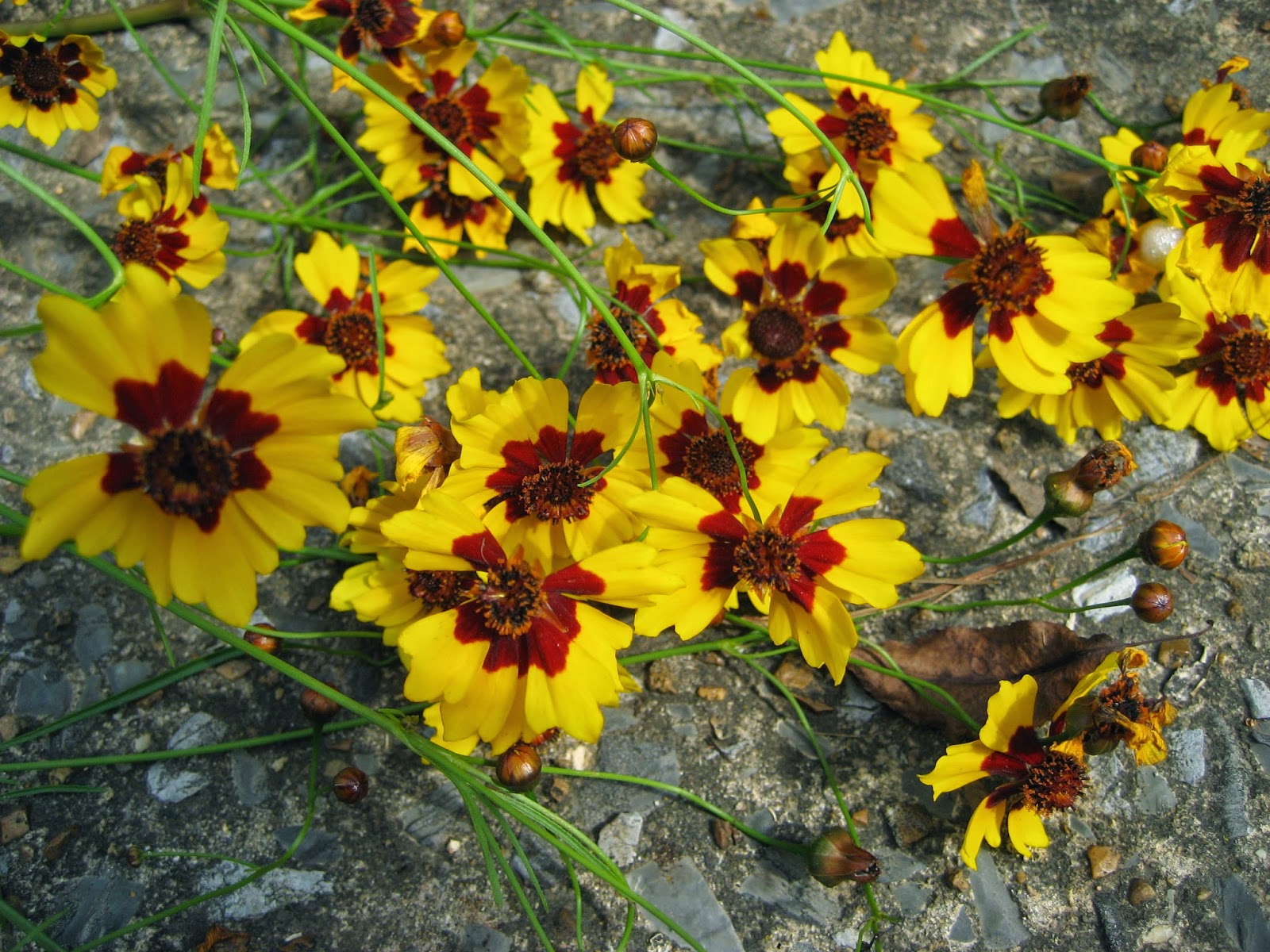
Golden Tickseed (Coreopsis Tinctoria)

This wildflower is from the Aster family and is different from the other Tickseed I've already photographed and written about. This one was on the side of the road in my neighborhood and from a weedy spot I might say. My son and I decided to move one of these up to our house. This particular spot had a few other things I'm spending some time identifying. I don't remember seeing Golden Tickseed when I was growing up here but maybe I didn't notice as many wildflowers as I do now. It also didn't use to be as woodsy as it's become. The flowers of this plant can be boiled to make a tea from. The blossoms can also be used to make a natural dye. I might have to try this if we have enough of blossoms I can gather. Maybe for a future project since discovering and identifying the wildflowers and other plants is keeping me busier than I planned this year. This year I'm taking a closer look at God's creation that surrounds me. I hope you will too. 


Golden Tickseed (Coreopsis Tinctoria) These were on the side of the road and had fallen over.

Golden Tickseed (Coreopsis Tinctoria)  These were growing on the side of the road and had fallen over.


Golden Tickseed (Coreopsis Tinctoria) We moved these from the side of the road to our backyard. I love the clouds in the background.  

Golden Tickseed (Coreopsis Tinctoria)


Golden Tickseed (Coreopsis Tinctoria) Now in our backyard. 

Golden Tickseed (Coreopsis Tinctoria) 

Thursday, June 12, 2014

Virginia Creeper (Parthenocissus Quinquefolia)

This plant is not one I write about with joy but total dislike.  It's true to it's name and creeps along the ground, trees and anything if not stopped. It covers much of the woods behind our property and tries to spring up and sneak it's way onto ours no matter how many times I remove it. It's native to Eastern and Central North America, Southeastern Canada, Eastern Mexico and Guatemala.  Everyone may not have their skin react like mine does when they come in contact with it or so I've read. It causes a skin rash just like poison ivy and oak would for me and my family members. Everyone in my house reacts the same way to it. Surprisingly I've read only a small percentage of people do though (not sure if that's true) ! I really would love to see someone not have a reaction to this plant! It's even hard for me to imagine anyone wanting to have it in their yard at all but it seems not to be a curse to everyone. :)  This plant contains oxalate crystals that could be described like microscopic chemical spines from a cactus. Painful is the only way I can describe it !  It amazes me though that the Native Americans were said to have used the roots and bark for various aliments as well as the berries. Yet the berries are highly toxic and could be fatal if eaten. Interesting to know that birds and some animals can eat those berries and leaves without harm though. I just simply want it no where near me but thank God that it is of use for something.  All of God's creation may not seem like a benefit but has a purpose and a place even when we don't understand it all. 


Virginia Creeper (Parthenocissus Quinquefolia) up close, climbing up a tree .

Virginia Creeper (Parthenocissus Quinquefolia) The tree in the very center is dead but covered from top to bottom in Virginia Creeper.

Virginia Creeper (Parthenocissus Quinquefolia)  growing up to the top of the tree. 


Virginia Creeper (Parthenocissus Quinquefolia)


Virginia Creeper (Parthenocissus Quinquefolia)

Saturday, June 7, 2014

Black-eyed Susan (Rudbeckia Hirta)

I've been watching and waiting for these blooms to open the past few weeks. These flowers were not planted where they are growing but came up on their own. When I first saw them I didn't know what they were but I decided not to mow over them. There was not a hint of a bloom at that point it just looked like it might be a wildflower coming up in a spot next to the Crepe Myrtle. So I left them and glad I did.  Black-eyed Susan is often seen in this area and once the blooms opened I knew for sure what they were. They are in the Aster family and are considered edible although are said to be toxic to cattle. For some people they can be a skin irritant. I had no problems with skin irritation when I came in contact with them though. They also have been used medicinally by the native Americans. They are said to attract butterflies and I hope to watch and capture some pictures this summer if they do. The yellow-orange flowers are lovely and the leaves have the softest feeling. I love just touching them. They are covered with tiny hairs which are described as bristly. The word hirta fits this plant well it's Latin for hairy. All thanks goes to my Father and Creator who placed and planted this in a nice spot for me to enjoy this summer. Hope you'll take some time to discover and enjoy God's creation today !

 Black-eyed Susan (Rudbeckia Hirta)

 Black-eyed Susan (Rudbeckia Hirta)

 Black-eyed Susan (Rudbeckia Hirta)

 Black-eyed Susan (Rudbeckia Hirta)


Black-eyed Susan  leaf (Rudbeckia Hirta)
Black-eyed Susan (Rudbeckia Hirta)


Tuesday, June 3, 2014

Whorled Leaf Coreopsis - Greater Tickseed- (Coreopsis Major)

Yesterday after finishing up mowing the lawn I decided to take the weed-eater to clear off a trail where Virginia Creeper was starting to grow over it. I sometimes see wildflowers there but really didn't expect to yesterday. I was surprised by bright yellow flowers on a cloudy day. They added some cheer to the drab woods before me. So of course I ran up the hill to get the camera. I didn't know their name but I had seen them before. I looked it up and found Whorled Leaf Coreopsis or Greater Tickseed is in the Aster family. It's native to Eastern and the South Eastern United States  and also Eastern Canada. I actually couldn't find anything stating if this plant is edible or not. Since it's in the Aster family you might would think it would be. Asteraceae are in general considered edible and medicinal but many contain alkaloids that can be medicinal but also harmful. Since I'm no expert and have no other information I can find now I will just admire their beauty !  So it's not on the edible list for now. Thank you God for your creation. The yellow rays of the Whorled Leaf Coreopsis brightened even a cloudy day ! :)


Whorled Leaf Coreopsis - Greater Tickseed-  (Coreopsis Major)

Whorled Leaf Coreopsis - Greater Tickseed-  (Coreopsis Major)

Whorled Leaf Coreopsis - Greater Tickseed-  (Coreopsis Major)

Whorled Leaf Coreopsis - Greater Tickseed-  (Coreopsis Major)

Whorled Leaf Coreopsis - Greater Tickseed-  (Coreopsis Major)

Sunday, June 1, 2014

Carolina Bristle Mallow (Modiola Caroliniana)

Sometimes when I search for  information on plants I come across one I'm not looking for but I recognize. That was the case with Carolina Bristle Mallow which is considered a weed. I see it occasionally and those small reddish pink flowers creeping along the ground. It's in the Mallow family and that's easy to tell by the name. As to it's edibility well, that's a little confusing to me. It's listed as poisonous to livestock but then I've read only in large quantities. It could be due to the fact that mallows contain nitrates. As for humans we can be subject to nitrate toxicity too. There are some accounts of people I found on the internet who claim it is edible and they had tried it. Everyone is not as sensitive to nitrates so I don't have a definite answer. It seems they have had no problems in eating it. So I'm left with the question to eat or not to eat ? :) Where are the experts ? The Houma Indians of Louisiana used it as a gargle for tonsillitis and sore throat and that's about all I have found. I would love more information if anyone has any. So many plants and herbs here and what a great Creator who made them all. I'm Discovering His Creation with new eyes that see this all different than before.