Friday, August 22, 2014

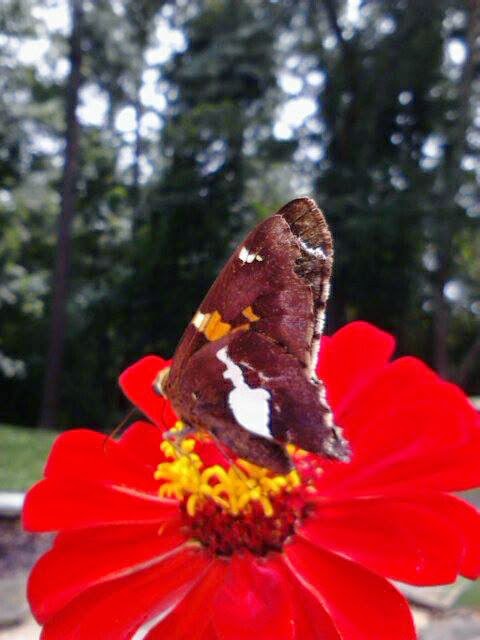
Silver-spotted Skipper Butterfly (Epargyreus clarus)

This blog will be a little different today. I've been writing about plants, weeds and wildflowers for the past few months. It's hard not to see butterflies though when photographing flowers. So my love for them has grown and there are days when I'm chasing butterflies for a closer look. One picture is never enough if they will be still. For the past few years I've noticed more butterflies here. I guess we have more flowers that they're attracted to. The Silver Spotted Skipper loves the Zinnias and in reading about them I found that they almost never visit yellow flowers. They love blue, red, pink and purple. Sometimes they also visit white or cream colored ones. They range from Southern Canada and down to Northern Mexico, covering most of the United States except the Great Basin and west Texas. They also can be seen worldwide and have been seen in parts of Europe, Asia and Australia. I have had someone comment when I shared the pictures on facebook askng if it was a moth. No, not a moth and maybe not the most beautiful of butterflies but still lovely. I'm learning more about God's creation. I hope you'll take time and learn also.  


Silver-spotted Skipper (Epargyreus clarus)

Silver-spotted Skipper (Epargyreus clarus)

Silver-spotted Skipper (Epargyreus clarus)

Silver-spotted Skipper (Epargyreus clarus)

Silver-spotted Skipper (Epargyreus clarus)

Silver-spotted Skipper (Epargyreus clarus)

Silver-spotted Skipper (Epargyreus clarus)

Tuesday, August 19, 2014

Hairy Leafcup (Smallanthus uvedalius) (Polymnia uvedalia)

This was another surprise plant for me, after the disappointment of finding a weedy spot mowed down (by the city) in my neighborhood. I was going back to take more pictures of other plants I was writing about. I was happy to find this seemingly out of their reach though. This isn't a plant I remember seeing here in this neighborhood and I have spent most of my life here. Glad I found it and was able to take some pictures and also glad to add it to my growing list. When I started blogging I had no idea I'd still be finding this many new plants to write about. Shows you how little I knew about what was actually here. Not to mention what is edible and medicinal all around me. Leafcup is found in the Eastern and Southeastern United States from New York to Florida, although it's on the endangered list in New York and New Jersey. It ranges to the Midwest through Illinois, Missouri and Nebraska also south to Texas. It's been used medicinally treating rheumatism and hair loss. The root was said to have have been used for the liver, spleen and stomach. A poultice of the root was used as a salve for burns, inflammation and cuts. I haven't found anything saying it's edible and it is listed under poisonous plants on the FDA but no information is given. As always be cautious, well informed and know a expert if considering using any plant your not familiar with. My blogs only give information not advice. Become a researcher and a discover of God's creation. There is so much to be learned ! 


Hairy Leafcup (Smallanthus uvedalius)

Hairy Leafcup (Smallanthus uvedalius)

Hairy Leafcup (Smallanthus uvedalius)

Hairy Leafcup (Smallanthus uvedalius)

Hairy Leafcup (Smallanthus uvedalius)


Hairy Leafcup (Smallanthus uvedalius)

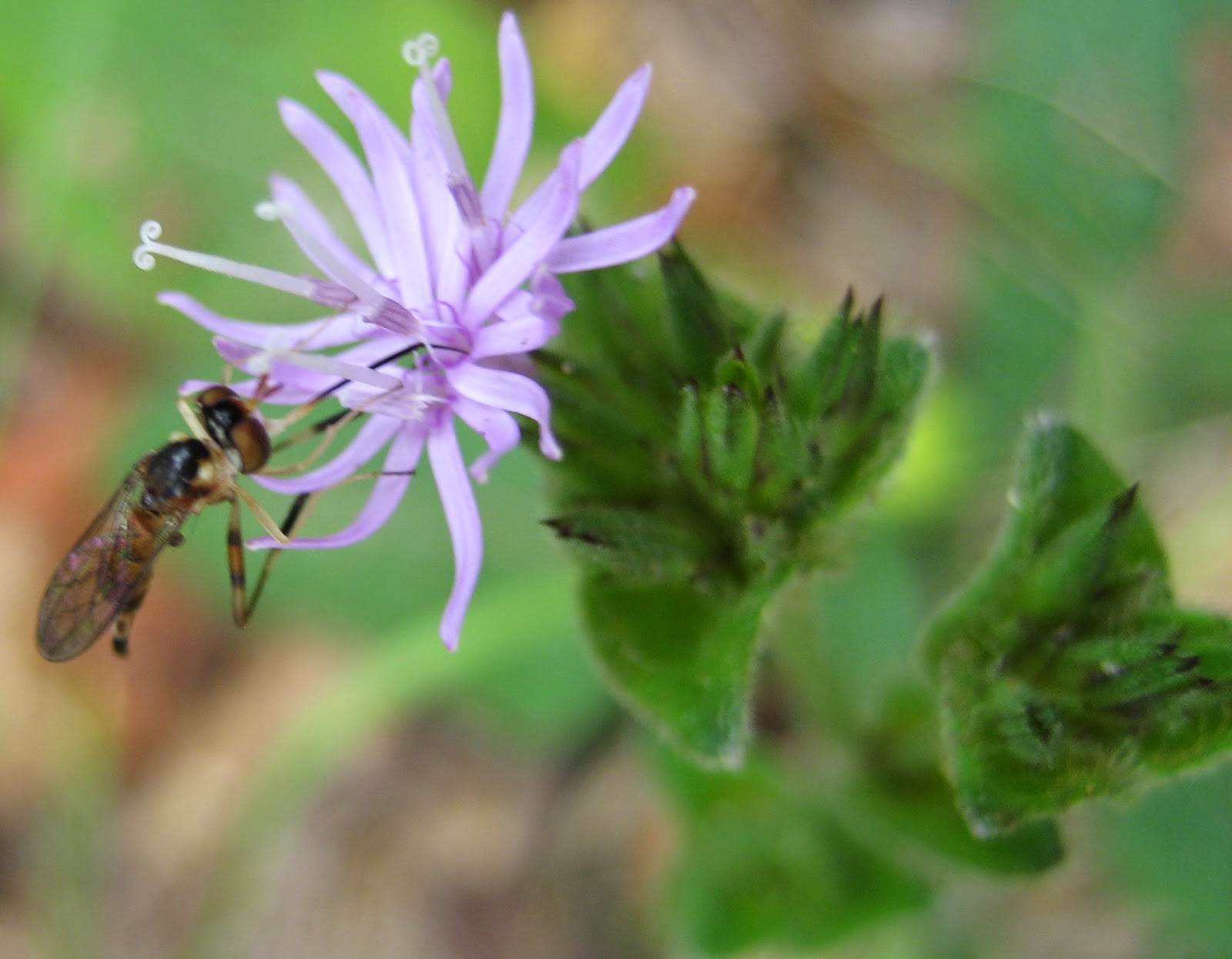
Hairy Elephant's Foot (Elephantopus tomentosus)

I caught sight of this after being disappointed that a weedy spot had been somewhat cut down. I came back to the spot to get some better pics of other plants I was blogging about. Unfortunately to find it had been mowed by the city. What they left though were a few things I didn't see before. This is one I don't think I remember seeing in the past but the name is vaguely familiar. It's a plant native to the Southeastern United States. The name seemed a bit odd when I found it but it does describe the leaves at the base of the plant well. Elephantopus tomentosus is used in Asia and especially in Malaysia in treating pain and inflammation. As for it being edible not much information to be found but parts are said to be poisonous. According to the FDA it's listed as a poisonous plant; containing "Cytotoxic germacraolides" . That's definitely a new word for me.  :) So maybe medicinal but no to edible and I would say more information needed ! God's creation is packed full of information if only man would look to the Creator to reveal to them more. Take some time and discover God's creation today. 


Hairy Elephant's Foot (Elephantopus tomentosus)

Hairy Elephant's Foot (Elephantopus tomentosus)

Hairy Elephant's Foot (Elephantopus tomentosus)

Hairy Elephant's Foot (Elephantopus tomentosus)

Hairy Elephant's Foot (Elephantopus tomentosus)

Hairy Elephant's Foot (Elephantopus tomentosus)

Hairy Elephant's Foot (Elephantopus tomentosus)

Monday, August 18, 2014

Brazilian vervain (Verbena brasiliensis)

In one of those nice weed patches in my neighborhood is where I found Brazilian Vervain. Not one I could completely figure out on my own. Since I'm so new to all this I got some help from a group on facebook. As some of the plants I write about and photograph I have seen this but never knew the name. I went back to get better pictures and wouldn't you know it the city had mowed it down. Glad they didn't do a very good job because I found a few other new plants. None to worry though because on my way down there God had provided one growing right at the edge of the road of one of the homes here. Sorry but perfectly kept lawns can't be found by everyone in this neighborhood and that in this case is a blessing. Brazilian vervain is native to South America namely Brazil and also found in coastal Europe, Southern Africa and Australasia. It's considered an invasive species in the mid-south United States and prohibited on National Forest lands. Vervain has long been used in herbal medicine as a tea. As far back as 1652 the folk uses were known and recorded by Nicholas Culpepper in The English Physician. Vervain has been used as a remedy for colds, a tonic, aid for digestion and ointment. As a reminder be cautious and well informed before trying or using any plant medicinally or as an edible. Knowing and having the advice of an expert would be recommended. Speaking of experts the one who created all things is still revealing to man the uses and benefits of so many plants He placed here. Take some time and discover God's creation. You may be surprised at what you learn !


Brazilian vervain (Verbena brasiliensis)
Brazilian vervain (Verbena brasiliensis) leaf 

Brazilian vervain (Verbena brasiliensis)

Brazilian vervain (Verbena brasiliensis)

Brazilian vervain (Verbena brasiliensis)

Brazilian vervain (Verbena brasiliensis)

Brazilian vervain (Verbena brasiliensis)

Brazilian vervain (Verbena brasiliensis)


Saturday, August 16, 2014

Monkey grass- Lilyturf ( Liriope muscari )

Monkey grass (Liriope) is originally from Eastern Asia and brought over to the United States around 150 years ago. Hard to remember a time when it wasn't in our yard or neighborhood somewhere. Although I usually keep it cut down in most areas now. It spreads where not wanted but still nice little purple flowers appear from it. Interesting Monkey grass is not considered a grass and is in the asparagaceae family. There are different types of Liriope but only one in my yard. The berries that grow on monkey grass could be eaten but are bitter and astringent. They contain phenolic compounds. The flowers and foliage have been listed as non-toxic but also said to cause stomach upset if consumed in large quantities. As always keep in mind of allergic reactions or sensitivity to new plants even if thought to be non- toxic. The roots have been used in Chinese medicine and this might be a good plant to further research. Interesting to learn that there are possibly more uses for Monkey grass than just a good border plant. I'm taking time to discover God's creation of plants, flowers and trees . Hope you'll take some time and discover God's creation also. 


Monkey grass- Lilyturf  ( Liriope muscari )

Monkey grass- Lilyturf  ( Liriope muscari )

Monkey grass- Lilyturf  ( Liriope muscari )

Monkey grass- Lilyturf  ( Liriope muscari )


Monkey grass- Lilyturf  ( Liriope muscari )

Tuesday, August 12, 2014

Partridge Pea - Golden Cassia (Chamaecrista fasciculata)

I found this in the same spot in my neighborhood as the Queen Anne's Lace. I haven't driven up this side of our neighborhood lately and decided to for a change of scenery. Glad that I did because I found a different flower. It wasn't one I remember seeing but the leaves resemble that of the Mimosa tree. This spot was full of the Partridge Pea which has pretty yellow flowers. I decided to bring some back to the house and transplant it . Hopefully it will do alright. This plant is native to most of the Eastern United States. The seed in this plant is one of the major food items of the northern bobwhite and some quail. In fact it is suppose to be one of the most important foods during the fall and winter for the bobwhite quail in my state of Alabama. It's also an important source of food for the Cloudless Sulphur, Sleepy Orange and Little yellow caterpillars. Bees also are attracted to the nectar that's found not in the flower but in a small orange gland at the base of each leaf. It can be poisonous to grazing animals and humans if eaten in large quantities because it contains cathartic. As for myself  I wouldn't consume it at all but Partridge Pea was used medicinally by the Cherokee and Seminole Indians. The early pioneers and Shakers used it to treat fevers and infections. There is a lot of information on this one if you're interested in it's use in the past but in modern herbal medicine it's not commonly used now. This has been a great find and discovery for me today. Don't overlook what God has placed around you. Take a look around and see the wonders of God's creation.


  Partridge Pea (Chamaecrista fasciculata)
  Partridge Pea (Chamaecrista fasciculata)

  Partridge Pea (Chamaecrista fasciculata)

  Partridge Pea (Chamaecrista fasciculata)

  Partridge Pea (Chamaecrista fasciculata)


Partridge Pea (Chamaecrista fasciculata)

c

Hairy Clustervine, Small Morning Glory (Jacquemontia tamnifolia)

I'm a little surprised to have found Hairy Cluster Vine or also called Small Morning Glory growing in the spot it was. I planted something else there that didn't come up at all. Funny but these are about the same color of what was supposed to have come up which was a violet color. Maybe we shall say God's garden. He's planting what He wants. When my Mother walked out of the door the other day she called them a Morning Glory and so she was right. I wasn't sure what these were until I looked them up today.They are in the Morning Glory family. I think I like it being here so I hope to see this next year. If it's like other Morning Glories we have it will spread and multiply quickly. This plant is found throughout Africa including Madagascar as well as some Indian Ocean Islands. It's native of tropical America. It's found in the Southeastern United States to Texas and North to Ohio and Pennsylvania. Traces of hallucinogenic alkaloids are present in the seeds just like other Morning Glories so the seeds should not be eaten. Not much information to be found as to it being edible. I did read that in Africa they would use the leaves in soups or eaten as a cooked vegetable. If it's safe or not I really don't know. This is another plant I would love to hear more information about. My advice is never eat any plant you're not sure if safe! Be well informed with information and with an expert's knowledge. I'm discovering God's creation and realizing how much there is to learn. Take some time and discover God's creation today.
Hairy Clustervine (Jacquemontia tamnifolia)

Hairy Clustervine (Jacquemontia tamnifolia)

Hairy Clustervine (Jacquemontia tamnifolia)

Hairy Clustervine (Jacquemontia tamnifolia)

Hairy Clustervine (Jacquemontia tamnifolia)

Hairy Clustervine (Jacquemontia tamnifolia)

c